


Multi-Aperture cores (2868015302)
68 MULTI-APERTURE CORE
68 Material
Suppression Components
Board Component
Printer Friendly Data Sheet
Catalog Drawing
3D Model
Check Stock
Part Number: 2868015302
68 MULTI-APERTURE CORE
Explanation of Part Numbers:
– Digits 1 & 2 = Product Class
– Digits 3 & 4 = Material Grade
– Last digit 2 = Burnished
Multi-aperture cores are used in suppression applications and in balun (balance-unbalance) and other broadband transformers. They are also employed in airbag designs to prevent accidental activation.
All multi-aperture cores are supplied burnished.
Our “Multi-Aperture Core Kit” (part number 0199000036) is available for prototype evaluation.
For any multi-aperture requirement not listed here, feel free to contact our customer service group for availability and pricing.
Weight: 18.2 (g)
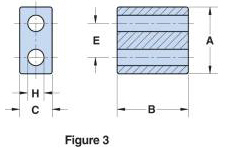
| Dim | mm | mm tol | nominal inch | inch misc. |
| A | 20.00 | ±0.40 | 0.787 | _ |
| B | 25.40 | ±0.70 | 1.00 | _ |
| C | 9.80 | ±0.25 | 0.386 | _ |
| E | 10.25 | ±0.25 | 0.404 | _ |
| H | 5.00 | ±0.2 | 0.197 | _ |

Chart Legend
+ Test frequency
| Electrical Properties | |
| AL(nH) | 96 Min |
Multi-aperture cores in 73 and 43 materials are controlled for impedance only. The 61 NiZn material is controlled for both impedance and AL value. The high frequency 67 material is controlled for AL value. Minimum impedance values are specified for the + marked frequencies. The minimum impedance is typically the listed impedance less 20%.
Multi-aperture cores in 73 and 43 material are measured for impedance on the E4990A Impedance Analyzer. The 61 and 67 multi-aperture cores are tested on the E4991A / HP4291B Impedance Analyzer. All impedance measurements are performed with a single turn to both holes, using the shortest practical wire length.
The 61 and 67 material multi-hole beads are tested for AL value. The test frequency is 10 kHz at < 10 gauss. The test winding is five turns wound through both holes.
Our highest frequency NiZn ferrite intended for broadband transformers, antennas and Hi Q inductor applications up to 150 MHz. Excellent stability characteristics.
Strong magnetic fields or excessive mechanical stresses may result in irreversible changes in permeability or losses.
Available in 68 material:
Toroids
Customer Specific Designs
68 Material Characteristics
| Property | Unit | Symbol | Value |
| Initial Permeability @ B < 10 gauss | µi | 16 | |
| Flux Density @ Field Strength | Gauss Oersted |
B H |
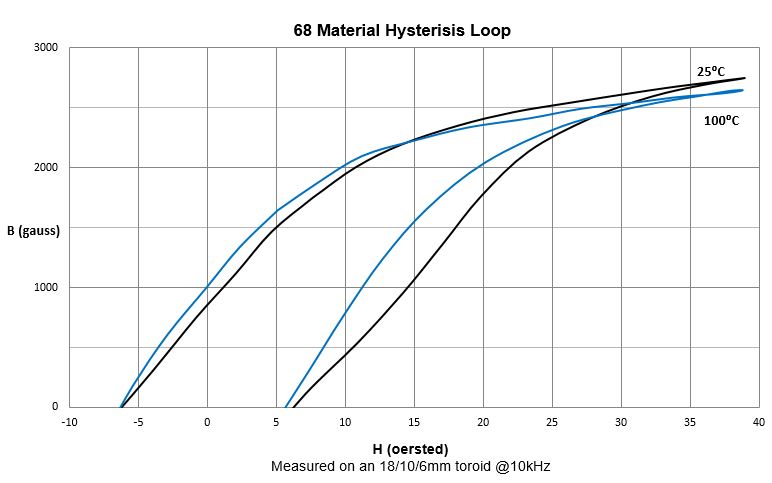
2700 40 |
| Residual Flux Density | Gauss | Br | 1000 |
| Coercive Force | Oersted | Hc7 | 7 |
| Loss Factor @ Frequency | 10 -6 MHz |
Tan δ/ µi | 300 100 |
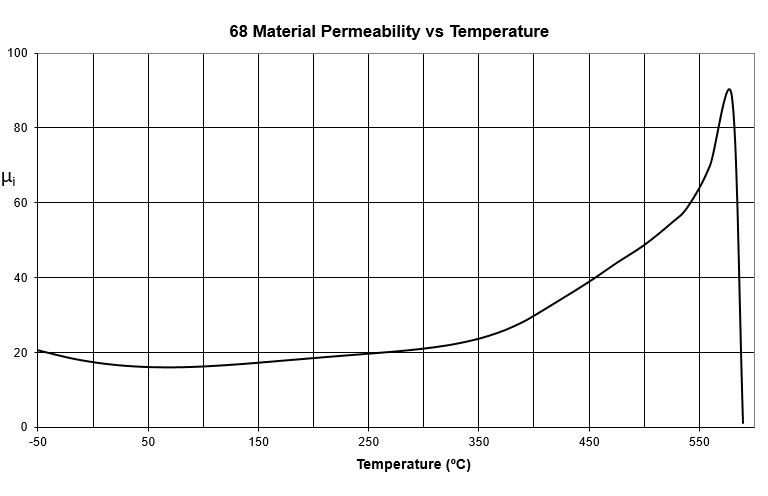
| Temperature Coefficient of Initial Permeability (20 -70°C) | %/°C | 0.10 | |
| Curie Temperature | °C | Tc | >500 |
| Resistivity | ohm-cm | ρ | 1×10⁷ |
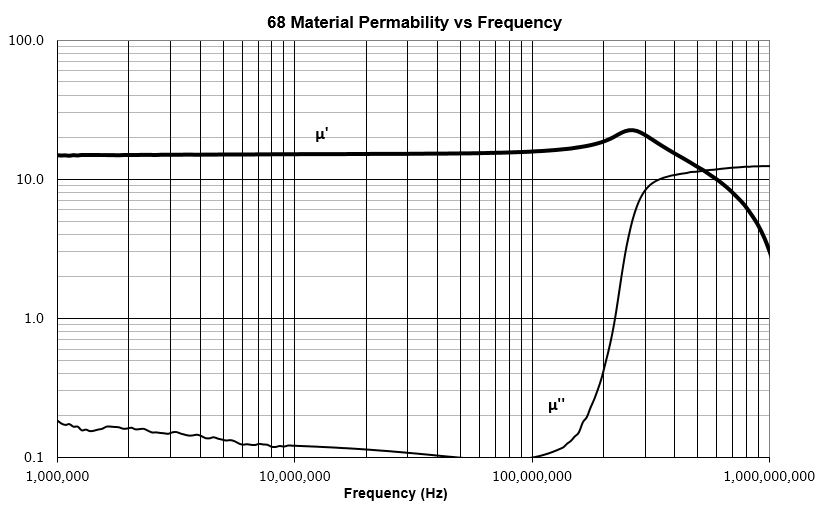
**** Characteristic curves are measured on standard Toroids (18/10/6 mm) at 25°C and 10 kHz unless otherwise indicated. Impedance characteristics are measured on standard shield beads (3.5/1.3/6.0 mm) unless otherwise indicated.
Material Safety Data Sheet (MSDS)
Click here to download Complex Permeability vs. Frequency (CSV)