Product Data Sheet Generated June 25, 2026
fair-rite.com

Rods (4061378111)

Part No. 4061378111
Rods (4061378111)
Part Number
4061378111
Description
61 ROD
Part Type
Rods
Frequency Range
61 Material™
Application Type
Inductive Components
Where Used
Open Magnetic Circuit
Material Grade
61
Ordering Information

Part Number: 4061378111

61 ROD

Explanation of Part Numbers:
– Digits 1 & 2 = Product Class
– Digits 3 & 4 = Material Grade

Pressed Fair-Rite rods are used extensively in high-energy storage designs.

These rods can also be used for inductive components that require temperature stability or have to accommodate large dc bias requirements.

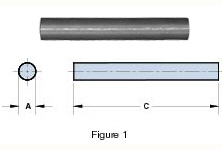
Figure 2 rods have a 0.6 mm (0.024) maximum chamfer on the end faces.

For frequency tuned rod designs see section Antenna/RFID Rods.

For any rod requirement not listed here, feel free to contact our customer service group for availability and pricing.

Mechanical Specifications

The A dimension can be centerless ground to tighter tolerances.

Weight: 8.6 (g)

Chart Legend
•Dimensions (Top numbers are in millimeters, bottom numbers are in nominal inches.).

Dimmmmm tolnominal inchinch misc.
A9.5±0.300.374_
C25.4±0.801_

Electrical Specifications

Figure 1 shows the rod permeability as a function of the length to diameter ratio for the six materials available in rods.

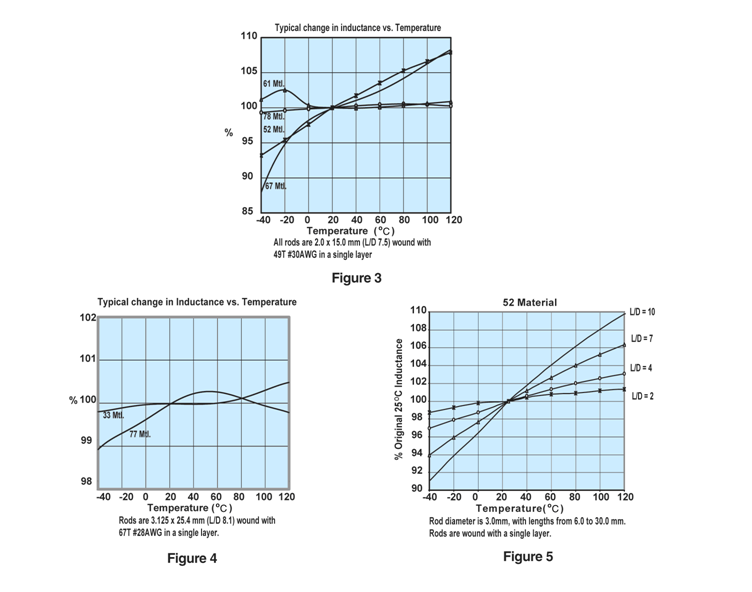
Figures 3, 4 and 5 illustrate typical temperature behavior of wound rods. Would rods in 33 and 77 material yield the best temperature stable inductors, see Figure 4. Both show a typical inductance change of <1% over the -40° to 120°C temperature range. The parts have a L/D ratio of 8.1. Lower ratios will change less. This is shown in detail in Figure 5 for the same 52 material but with the L/D ratio as the parameter. A lower ratio means a lower rod permeability but with improved temperature stability.

Figure1&2

Wound Rod Inductance Calculations

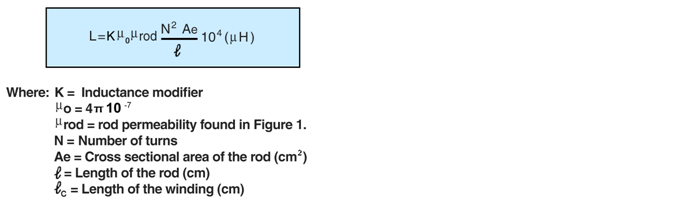
To calculate the inductances of a wound rod the following formula can be used,
 WoundFormula

The inductance modifier is found in Figure 2. The ratio winding length divided by the rod length will give the inductance modifier. If the rod is totally wound the K=1. Shorter but centered winding will yield higher K values.

 Using the rod 3061990871 as an example.

For this rod the length over diameter ratio is 8.33 and for 61 material Figure 1 gives a µrod of 29. The rod has an AE= 0.0707 cm² and ?=2.5 cm.

A winding of 80 turns of 30 AWG wire will yield a fully wound rod, therefore K=1.

Using the formula the calculated inductance is 65.96µH.

 The measured values for both winding were 66.95 and 39.50µH respectively.
 Figures3-5


This document was generated automatically from Fair-Rite's product database. For the most current specifications, visit fair-rite.com.